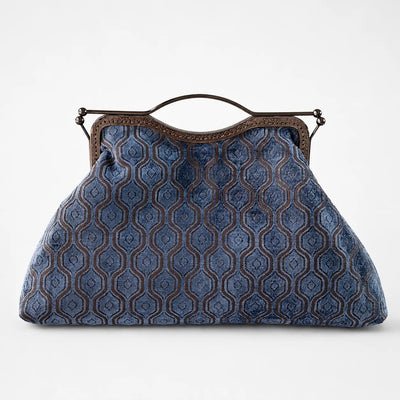
Most bags sold in the UAE are not handmade. This is not a criticism — it is simply the reality of how the luxury market operates at scale. When a brand produces hundreds of thousands of units per season, the human element of construction becomes logistically incompatible with the volume required.
What this means, practically, is that genuine handcraft is rare. And rare things require a different kind of search.
What "Handmade" Actually Means

The word is used loosely in fashion. A bag described as handmade might mean the hardware was attached by hand at the final stage. It might mean a craftsperson supervised a machine process. It might mean something assembled in a workshop rather than a fully automated factory.
None of these are fraudulent claims, exactly. But they are not the same as a bag where every structural decision — the tension of the stitch, the placement of the seam, the behaviour of the fabric at the corner — was made by a person paying attention to that specific piece.
The distinction matters if you are looking for something that will age differently from everything else in your wardrobe. Mass production optimises for consistency. Handcraft optimises for the individual object. If you want to understand what makes a bag genuinely worth the price, this distinction is where the answer begins.
Where Most People Look — and Why It Rarely Works
The obvious places to search in the UAE are the obvious places: Dubai Mall, Mall of the Emirates, the boutiques along Sheikh Zayed Road. These spaces house the international luxury houses that have spent decades building recognition.
What they do not house, with very few exceptions, is genuinely handmade work.
The economics make it difficult. Rent in Dubai's premium retail locations is among the highest in the world. To justify that cost, brands need volume. Volume and handcraft are structurally at odds. The result is that the most visible retail spaces in the UAE are also, almost by definition, the least likely places to find a piece made by hand.
The Shift Toward Independent Brands Online

The more productive search, for buyers who know what they are looking for, has moved online.
Independent ateliers — small by design, limited by intention — operate differently from the houses with flagship stores in every major city. They do not need the retail footprint. They do not need the volume. What they need is a buyer who understands what they are making and why it costs what it costs.
In the UAE specifically, this shift has accelerated. A generation of buyers who grew up purchasing luxury in-store has become comfortable acquiring considered pieces through direct channels — from the brand's own website, through private consultation, or through appointment-based viewing.
The result is that some of the most interesting handmade work available in the UAE is not visible in any mall. It exists online, made in small quantities, by people whose entire operation is built around the quality of the object rather than the scale of the distribution. This is part of a broader shift toward quiet luxury — where the material speaks instead of the label.
What to Look for When Evaluating a Handmade Claim
Before purchasing any piece described as handmade, these are the questions worth asking — and the answers worth trusting:
Can the brand show you the material origin? A genuinely handmade bag built around quality will have a specific answer to where the fabric or leather comes from. "Italian woven fabric" is a specific claim. "Premium materials" is not. For context on why material origin matters, see our guide to what gobelin fabric actually is.
Is the production limited — and verifiably so? A handmade piece exists in finite quantity almost by necessity. If a brand describes its work as handmade but offers unlimited availability, that tension is worth examining.
Does the brand have a clear construction process? Not a marketing paragraph — a real description of how the bag is built. What holds the structure together. How the edges are finished. Whether the lining is attached by machine or by hand.
Is there a person behind the work? The best independent ateliers have a point of view that is traceable to a specific sensibility. The design choices are not trend-responsive — they are the result of someone deciding what the object should be and building toward that.
Souks, Markets, and Craft Fairs — An Honest Assessment
Dubai and Abu Dhabi both host periodic craft markets and design fairs where independent makers show work. These are worth visiting for the experience and for discovering emerging talent.
For a handmade handbag that will function as a serious wardrobe piece, however, the craft fair context has limitations. The work shown tends toward decorative or experimental. The construction standards vary widely. And the provenance of materials is not always traceable.
This is not a dismissal — it is a calibration. Markets are excellent for discovering what is being made in the region. They are less reliable as a source for the kind of considered, durable object that justifies a meaningful investment.
The Case for UAE-Based Ateliers

There is a specific advantage to sourcing from a brand based in the UAE, even if the materials come from elsewhere.
Proximity means accountability. A brand operating out of Dubai is reachable. Questions about the piece, requests to see additional detail, the possibility of a private viewing — these are practical options when the brand is local, not logistical challenges.
It also means the brand understands its buyer. The climate, the context, the cadence of life in the Gulf — a UAE-based atelier is designing for a specific reality, not adapting a European template to a different market.
Hirsch Atelier was built around exactly this logic. The bags are made from Italian woven fabrics — gobelin, jacquard, velvet — chosen for their texture, their history, and their behaviour over time. Each piece is produced in strict limited quantity. Some are made once. The brand is based in Dubai and operates through hirsch.ae. For more on the full range of luxury handbags available in Dubai, we have covered that separately.
A Practical Search Guide
For anyone actively looking for handmade handbags in the UAE, a realistic approach:
Start online. Search specifically for UAE-based independent brands, not international houses with UAE stockists. The language to use: "handmade handbag UAE," "artisan bag Dubai," "limited edition bag UAE." The results will be sparse — which is informative in itself.
Look at what the brand shows, not what it claims. Photography that shows material detail, construction close-ups, and process imagery signals that the maker is proud of how the object is built. Generic product shots against white backgrounds signal something else.
Read the copy carefully. Brands that make things well tend to describe them specifically. Vague luxury language — "exceptional quality," "finest materials," "unparalleled craftsmanship" — is a reasonable signal that the specifics do not hold up to scrutiny.
Ask questions. A brand that makes things by hand will have detailed answers. Response time, tone, and the specificity of the reply are all information.
The Piece That Was Made for You — Without Being Made to Order
There is a category of object that sits between bespoke and mass production. Not made to your specification, but made in such limited quantity — and with such specific material choices — that finding one that speaks to you feels personal anyway.
This is what genuine handcraft produces at its best: an object with enough individuality that the person who finds it feels, correctly, that it was not made for everyone.
In the UAE, where the market defaults to abundance and availability, that kind of scarcity is not a flaw in the offering. It is the point.
FAQ
Are there handmade handbag brands based in the UAE?
Yes, though they are few. Hirsch Atelier is one — producing handmade bags from Italian woven fabrics in limited quantities, available at hirsch.ae.
Where can I buy artisan handbags in Dubai?
Most genuine artisan work is not available in mainstream retail. Independent brands operating online, or through private appointment, are the more reliable source. Craft markets and design fairs offer exposure but variable quality.
What should I look for to verify a bag is truly handmade?
Specific material provenance, limited production numbers, visible construction detail in product photography, and a brand that can answer detailed questions about how the piece is built.
Is it possible to view handmade bags in person in Dubai?
Some UAE-based independent ateliers offer private viewings by appointment. This is worth requesting directly with the brand.