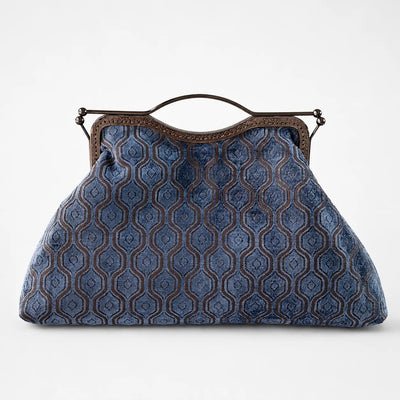
There are materials that exist because they are practical. And there are materials that exist because someone, at some point, decided that a textile could be something more than functional — that it could carry image, narrative, and time.
Gobelin is the second kind.
It is one of the oldest continuously produced woven textiles in European history. It has covered the walls of royal residences, been gifted between heads of state, and served as the medium through which some of the most skilled craftspeople of the last four centuries expressed what their era looked like. It is not a fabric that arrived recently. It arrived slowly, over centuries, and it stayed.
The question worth asking is not what gobelin is. The question is why it took this long for someone to put it on a handbag.
The Origin

The name comes from a place — or more precisely, from a family.
The Gobelin family established a dyeing workshop on the outskirts of Paris in the fifteenth century. By the mid-seventeenth century, Louis XIV had absorbed the operation into the French royal manufactory, transforming it into the institution now known as the Manufacture des Gobelins — a state enterprise dedicated to producing woven works for the Crown.
What came out of this manufactory was not fabric in the ordinary sense. It was tapestry: woven images, built thread by thread on vertical looms, depicting battles, allegories, landscapes, and portraits with a precision that rivalled painting. The technique required weavers to work from the reverse side, following a cartoon — a full-scale design — placed behind the loom. Every colour transition, every gradation of light and shadow, was achieved through the placement of individual threads.
This is the origin of what is now called gobelin fabric. The industrial and commercial versions that followed simplified the process considerably. But the essential character of the weave — its density, its visual depth, its capacity to hold pattern with extraordinary fidelity — derives directly from this tradition.
How It Is Made
Modern gobelin fabric is produced on power looms rather than by hand, but the structural logic remains the same as its tapestry ancestor.
The weave interlocks weft threads — the horizontal ones — with warp threads — the vertical ones — in a pattern that completely covers the warp. This is called a weft-faced weave. The result is a fabric where the surface is entirely composed of the decorative threads, with no visible ground. The pattern is not printed onto the surface. It is built into the structure of the fabric itself.
This distinction matters enormously in practice. A printed pattern sits on top of a fabric. It can fade, crack, or wear unevenly over time. A woven pattern is the fabric — embedded in its structure, present through its entire thickness, impossible to separate from the material without destroying it.
The density of a gobelin weave also gives it a particular weight and rigidity. It does not drape like silk or move like chiffon. It holds its form. This is not a limitation — it is a quality. For an object that needs to maintain its shape through daily use, a fabric that holds itself is precisely what is required.
The Visual Character

Gobelin is immediately recognisable to anyone who has spent time around it, and genuinely distinctive in a market where most bags are made from leather, coated canvas, or nylon.
The surface has depth. The interlocking of coloured threads creates a visual complexity that changes slightly depending on the angle of light — a quality that photography captures imperfectly and that rewards physical proximity. What appears to be a single colour at a distance reveals itself, up close, to be composed of several tones woven together.
The patterns traditionally associated with gobelin — florals, geometrics, botanical motifs — carry a specific cultural weight. They read as European, historical, and handcrafted even in their machine-produced versions, because the technique itself is inseparable from that history.
On a handbag, this visual character does something no leather or canvas can do. It gives the object a specific cultural address. It places it in a tradition. It makes it legible, to anyone who recognises the material, as something chosen with knowledge rather than assembled from defaults.
Gobelin Against Other Woven Fabrics
Gobelin is one member of a family of woven textiles, each with distinct characteristics.
Jacquard is the broader category — a weaving method, not a specific fabric, that uses a programmable loom to produce complex patterns. Gobelin is a type of jacquard weave, but not all jacquard is gobelin. To understand the precise difference, see our guide to jacquard vs gobelin.
Brocade is a jacquard weave where supplementary threads are woven into the base fabric to create a raised pattern. The effect is more sculptural than gobelin, but also more fragile — the supplementary threads can snag or pull in ways that the fully interlocked gobelin weave does not allow.
Tapestry fabric, in its commercial form, is often used interchangeably with gobelin, and the distinction is largely one of marketing rather than construction. True tapestry, like the works produced at the Manufacture des Gobelins, is handwoven. Commercial tapestry fabric is machine-produced using the same structural principles.
Velvet occupies a different category entirely — a cut-pile weave that creates a soft, directional surface. Where gobelin reads as flat and architectural, velvet reads as tactile and warm. The two materials represent opposite ends of the woven textile spectrum, and both have a long history in European luxury.
Why It Belongs on a Handbag

The conventional answer to the question of what a luxury handbag should be made from is leather. Leather has dominated the category for the better part of a century, and for good reasons: it is durable, it ages well, it has a long and legible history in the craft.
But leather is also, at this point, the expected answer. And the most interesting objects are rarely produced by reaching for the expected answer.
Gobelin on a handbag does several things simultaneously.
It brings material history into an everyday object. A fabric with four centuries of craft tradition behind it — woven using a technique developed for royal commissions — carries that history into whatever it becomes. The bag is not merely a bag. It is a continuation of something.
It makes the object visually specific in a way that leather cannot. Two leather bags of similar quality can be distinguished only by cut and hardware. Two gobelin bags are immediately distinct — the pattern, the colourway, the particular density of the weave make each one singular in a way that leather does not allow.
It ages differently. Leather softens and develops patina. Gobelin holds its form and its pattern. The character of the bag does not change with use — it simply becomes more familiar.
And it removes the piece from the logic of the logo entirely. A gobelin bag does not need a name on it to be recognisable as something considered. The material itself is the statement — legible to anyone who understands textiles, silent to anyone who does not. This is precisely the quality that quiet luxury requires.
For buyers in the UAE specifically, this distinction carries particular weight. The luxury handbag market in Dubai is one of the most saturated in the world — and precisely because of that saturation, the case for material-driven design over logo-driven design is more visible here than almost anywhere else.
The Hirsch Position
Hirsch Atelier was built around this material not because gobelin is fashionable — it is not, in any conventional sense — but because it is exactly right for what the brand is trying to make.
A handmade bag. A limited object. A piece with a specific cultural address and a visual depth that rewards attention. A piece that does not look like anything else currently being made.
Gobelin makes all of this possible in a way that leather does not. It is the material that allows the object to be what it needs to be.
Each piece in the Hirsch Atelier collection is made from Italian woven fabric — gobelin, jacquard, or velvet — sourced for its specific pattern and weight, and constructed by hand in strict limited quantities. Some pieces exist as single objects. None are produced at volume.
This is not a constraint. It is the point. If you want to understand what makes a bag worth the price, the material is always where that answer begins.
FAQ
What is gobelin fabric?
Gobelin is a dense weft-faced woven textile with origins in the French royal tapestry tradition. Its defining characteristic is a pattern woven into the structure of the fabric itself, rather than printed on the surface. The result is a material with visual depth, structural weight, and exceptional durability.
Is gobelin the same as tapestry fabric?
In commercial use, the terms are often used interchangeably. True tapestry is handwoven; commercial gobelin is machine-produced using the same structural principles. Both are weft-faced weaves with the pattern built into the fabric structure.
Is gobelin fabric durable?
Yes. The density of the weave makes it structurally robust. Unlike printed fabrics, the pattern cannot fade or crack independently of the material. For objects subject to daily use — like handbags — this durability is a significant advantage.
Why is gobelin fabric used in luxury handbags?
Its visual complexity, material history, and structural qualities make it distinctly suited to objects meant to last and to carry meaning. It provides a visual specificity and cultural depth that leather and coated canvas cannot replicate.
Where can I find gobelin handbags in the UAE?
Hirsch Atelier produces handmade handbags in the UAE from Italian gobelin, jacquard, and velvet fabrics in limited quantities. Pieces are available at hirsch.ae.