There is a question that almost every serious buyer eventually asks, and almost no brand will answer directly.
Why does this cost what it costs?
The luxury industry has become very skilled at deflecting the question. The answer is usually supplied in the form of a campaign image, a heritage narrative, or a waiting list — signals that are designed to make the question feel beside the point. If you have to ask, the implication goes, perhaps this is not for you.
This is a poor answer. And it has allowed a significant amount of mediocre product to carry extraordinary prices for a very long time.
The question deserves a direct response. Here is one.
The Three Things That Actually Justify Price
When the marketing is stripped away, the price of a serious handbag is determined by three things: what it is made from, how it is made, and how many of them exist. Everything else — the logo, the campaign, the boutique address — is overhead, not value.
These three factors interact. A bag made from exceptional material but assembled carelessly is not worth a high price. A bag made with extraordinary craft from a mediocre material is a curiosity, not an investment. And a bag produced in unlimited quantities, regardless of its material or construction, will never be rare in any meaningful sense.
The price is justified when all three are present simultaneously. This is rarer than the market would suggest.
Material: Where the Value Begins
The outer material of a handbag is the first and most consequential decision in its construction. It determines how the bag ages, how it holds its shape, how it responds to daily use, and how it looks to anyone who knows what they are looking at.
Leather has dominated the luxury handbag category for decades, and for understandable reasons. Full-grain leather, properly tanned and finished, is durable, develops character with age, and has a long and legible craft history. It is also, at this point, the expected answer — which means that within the leather category, differentiation has become increasingly difficult.
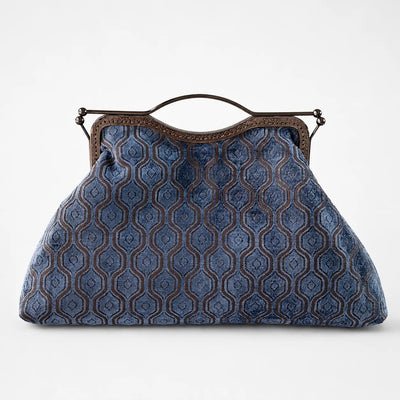
Woven textiles — gobelin, jacquard, brocade — occupy a different position entirely. They are rarer in the handbag category, more technically demanding to work with, and carry their own long history in European luxury. A gobelin fabric has four centuries of craft tradition behind it. The pattern is not printed onto the surface — it is built into the structure of the weave itself, thread by thread. It cannot fade independently of the material. It does not crack or peel. It holds its form.
This is what premium material actually means: not expensive by reputation, but valuable by construction. The difference is visible to anyone who knows how to look.
Construction: Where the Price Is Earned
Material quality alone does not make a bag worth its price. The construction is where the investment is either justified or squandered.
Machine production optimises for consistency and speed. At sufficient quality, it produces acceptable results. But it cannot replicate what happens when a person makes a specific decision about a specific piece — the tension of a stitch placed by hand, the alignment of a pattern at a seam, the way an edge is finished when someone is paying attention to that edge specifically.
Hand construction is slower, more expensive, and produces a different kind of object. Not necessarily a perfect one — handmade things carry the evidence of their making, which is part of what makes them interesting. But an object where every structural decision was made by a person, rather than executed by a machine, ages differently. It was built to last because someone chose, at each step, to build it that way.
The markers of genuine hand construction are visible if you know where to look: the behaviour of the seam under tension, the precision of the finish at stress points, the way the lining is attached, the consistency of the stitching. These details are not decorative. They are structural. And they are what determine whether a bag remains in good condition after a decade of use or begins to fail after a season.
Scarcity: Why Production Volume Matters
The third factor is the one most frequently manipulated, and therefore the most important to understand correctly.
Scarcity in the luxury market is often manufactured — limited editions that are not particularly limited, waiting lists that function as marketing devices, numbered pieces produced in quantities that make the number meaningless. This kind of artificial scarcity is a pricing mechanism, not a quality signal.
Genuine scarcity is a byproduct of the first two factors. When a bag is made by hand, from a specific material sourced in limited quantity, by a maker who produces a finite number of pieces per year — the scarcity is not a strategy. It is an arithmetic result.
What the Logo Actually Costs You
The most expensive component of many luxury handbags is not the material, not the construction, and not the scarcity. It is the name on the clasp.
Brand overhead — retail locations in premium districts, global campaigns, celebrity partnerships, the infrastructure of recognition — is substantial. It is also entirely legitimate as a business model. The question is whether you are paying for it knowingly.
The clearest way to test this: cover the hardware. Remove the logo from the equation entirely. Does the bag still hold your attention? Is the material still interesting? Is the construction still visible? If the answer is yes, the price is potentially justified. If the bag becomes ordinary without its name, you have your answer.
The Arithmetic of Long-Term Value
A bag that costs AED 3,000 and lasts fifteen years costs AED 200 per year. A bag that costs AED 800 and needs replacing after two seasons costs AED 400 per year — and generates twice the waste.
This arithmetic is straightforward, but it requires a different way of thinking about purchase decisions. The initial price is not the cost. The cost is the price divided by the useful life — and the useful life is determined almost entirely by material and construction quality.
A bag made from a woven Italian fabric, hand-constructed in limited quantity, does not have a useful life measured in seasons. It has a useful life measured in decades. The pattern does not fade. The structure does not collapse. The material does not separate from itself.
| Mass Market | Logo Luxury | Hirsch Atelier | |
|---|---|---|---|
| Material | Synthetic / faux leather | Leather / coated canvas | Italian gobelin, jacquard, velvet |
| Production | Fully machine-made | Partially handmade | Fully handmade |
| Edition size | Thousands | Hundreds | 1–10 pieces |
| Lifespan | 1–2 seasons | 3–5 years | 10–20 years |
| Cost per year of use | High | Medium | Low |
| What you are paying for | Trend, convenience | Brand recognition | Material + craft + rarity |
How to Evaluate Before You Buy
The practical question is how to apply this framework before a purchase, rather than after. These are the four questions worth asking, in order of importance.
- What is the outer material, specifically? Not the category — the specific material, its origin, and how it was produced. Italian gobelin from a named mill is a different thing from printed tapestry described as woven.
- How was this bag constructed? A brand that makes things by hand will be able to describe the process specifically. Vague answers about “artisanal quality” are not an answer.
- How many of this piece exist? Not the edition size on the label — the actual production run. A bag made in strict limited quantity by a small atelier is a different object from a bag produced at scale and described as limited.
- What does this bag look like without its branding? Cover the logo. Ignore the name. Is the object itself interesting? Does the material reward attention? These questions separate object value from brand value.
“The initial price is not the cost. The cost is the price divided by the useful life.”
A Note on Hirsch Atelier
Every bag in the Hirsch Atelier collection is made from Italian woven fabric — gobelin, jacquard, or velvet — sourced specifically for its pattern, weight, and behaviour. Each piece is constructed by hand. Production is strictly limited; some pieces exist as single objects.
The price reflects the material, the construction, and the scarcity. Not a campaign. Not a boutique address. Not a waiting list.
If you are looking for luxury handbags in Dubai where the price reflects something real, or want to find handmade bags in the UAE built to last — the pieces are available at hirsch.ae.
FAQ
What makes a luxury handbag worth the price?
Three things: the quality of the material, the method of construction, and the genuineness of the scarcity. When all three are present, the price reflects something real. When one or more is absent, you are paying for brand overhead rather than object value.
Is a handmade handbag worth more than a machine-made one?
Not automatically — but genuinely hand-constructed bags are structurally different from machine-produced ones. The construction method determines how the bag ages and how long it remains in good condition.
How can I tell if a bag is actually good quality?
Look at the material specifically — not the category, but the actual material and its origin. Examine the construction at stress points: seams, edges, corners, the attachment of handles. Ask how many pieces were made. Cover the logo and assess whether the object holds your attention on its own terms.
Are expensive handbags a good investment?
Some are. The ones that hold or increase in value share common characteristics: genuine material quality, hand construction, limited production, and a design that does not depend on seasonal relevance.
What is the difference between price and value in a handbag?
Price is what you pay at the point of purchase. Value is what you receive over the life of the object. A bag that costs more but lasts significantly longer may represent better value than a cheaper alternative that fails within a few seasons. Understanding quiet luxury helps reframe this calculation entirely.