Every few years, fashion discovers something it always knew and gives it a new name.
Quiet luxury is the current version of this. The term spread quickly — through editorial coverage, through social media, through the particular speed at which aesthetic categories travel now. And with that speed came the usual distortion: a genuine idea reduced to a mood board, a philosophy flattened into a checklist of neutral tones and unbranded knitwear.
The idea beneath the label, however, is real. And it is older than the label by several decades.
Where the Idea Comes From
The impulse to dress without announcement has existed as long as there have been people wealthy enough not to need the announcement.
Old European money — the kind that does not need to prove itself — has always dressed this way. Not from modesty, exactly, but from a different relationship to visibility. When your position is secure, the performance of it becomes unnecessary. The coat does not need to signal anything. It simply needs to be exceptional.
This is the original logic of quiet luxury, and it has nothing to do with minimalism as an aesthetic trend. It is about a specific kind of confidence: the kind that does not require external confirmation.
In fashion terms, this translated into a particular set of values. Material quality over surface decoration. Proportion and cut over embellishment. Pieces that reward proximity — that look more interesting the closer you get — rather than pieces designed to read from across a room.
What Quiet Luxury Is Not
The confusion around the term comes partly from what gets included under it.
Quiet luxury is not simply beige. Wearing neutral colours without logos is not the same as making considered choices about quality and construction. A fast fashion piece in camel and cream is not quiet luxury — it is an imitation of its visual surface.
Quiet luxury is not minimalism. Minimalism is an aesthetic position — a preference for reduction, for negative space, for the absence of decoration. Quiet luxury is a value position. It is about where the quality lives, not how much or how little is present.
Quiet luxury is not anti-fashion. The people who dress this way are often deeply engaged with fashion — more so, in some ways, than those who follow trends closely. The engagement is just directed differently: toward understanding materials, toward recognising construction, toward building a wardrobe that does not need to be refreshed every season.
And quiet luxury is not affordable. This is the most uncomfortable part of the honest definition. The values it describes — material integrity, limited production, genuine craft — cost money. Not because luxury brands have decided to charge more, but because these things are genuinely more expensive to produce.
What It Actually Requires
If you strip away the aesthetic surface — the neutral palette, the unbranded exterior, the clean lines — what remains is a set of demands placed on the object itself.
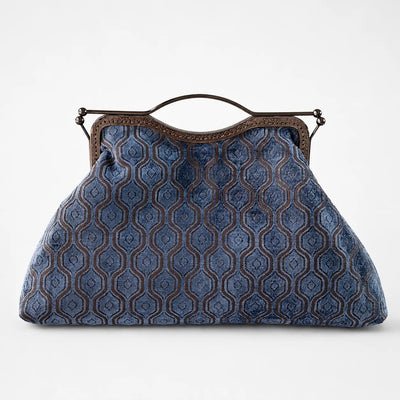
The material must justify itself. In quiet luxury, the fabric or leather is not a backdrop for hardware or branding. It is the point. A gobelin weave, a fine jacquard, a velvet that has weight and movement — these are materials that carry meaning without requiring decoration.
The construction must be visible to the right eye. A quietly luxurious object reveals its quality through detail — the way a seam behaves, the precision of a finish, the behaviour of the material at stress points. This is not hidden quality. It is quality that does not need to be announced because it is apparent to anyone paying attention.
The piece must have an identity that is not trend-dependent. A bag that looks timeless because it is generic is not the same as a bag that looks timeless because it was designed with conviction. The former will start to look dated. The latter simply continues to be what it is.
The production must be limited enough to mean something. An object available to anyone who can afford it is not quiet in any meaningful sense — it is simply expensive. The scarcity that gives quiet luxury its character is not manufactured. It comes from the fact that making things well, by hand, in small quantities, produces a finite number of objects.
The Role of Accessories
Clothing is the most visible expression of quiet luxury, but accessories are often the more precise one.
A wardrobe built around considered basics leaves the accessory as the point of differentiation — the place where a specific choice becomes visible. And because an accessory is carried or worn in direct contact, its material quality is experienced physically, not just observed visually.
A bag, in this context, is not decoration. It is the object through which the logic of the entire wardrobe is either confirmed or undermined.
A piece made from woven Italian fabric — from gobelin or jacquard, materials with centuries of craft history — does something that a logo-embossed canvas cannot. It carries texture, weight, and specificity. It ages differently. It does not look like anything mass-produced, because it was not mass-produced.
This is the accessory that quiet luxury actually requires: not the expensive version of the obvious choice, but the considered alternative to it.
Why Dubai Is an Interesting Place for This Conversation
Dubai is often read as the opposite of quiet luxury — a city of visibility, of scale, of deliberate display. That reading is not entirely wrong, but it misses something.
Beneath the surface of a city built around spectacle, there has always been a layer of buyer who operates differently. Who has owned every logo and found it insufficient. Who is looking for something that reflects a more specific sensibility than any mass-luxury brand can offer.
This buyer is not rare in Dubai. She is simply not the loudest. If you are looking for luxury handbags in Dubai that communicate through material rather than logo, the options are fewer — but they exist.
The conversation about quiet luxury is particularly resonant here because the contrast is so visible. In a market where display is the default, the choice to step outside it is more deliberate — and more legible — than it would be elsewhere.
What Changes When You Dress This Way
The practical effect of dressing with this logic is subtle but cumulative.
The wardrobe becomes smaller and more coherent. Individual pieces carry more weight — not because they are more expensive, but because each one was chosen with more precision. The relationship to shopping changes: from a response to availability and trend to a search for specific things that meet specific criteria.
And the experience of dressing changes. When every piece in a wardrobe was chosen deliberately — for its material, its construction, its particular identity — getting dressed stops being a negotiation and becomes a confirmation.
This is what quiet luxury produces at its best: not an aesthetic, but a clarity. A wardrobe that knows what it is, worn by someone who knows what she wants. If you want to understand what makes a bag worth the price, that clarity is exactly where the answer begins.
That is harder to achieve than it sounds. And significantly more satisfying than any logo.
FAQ
What is quiet luxury?
Quiet luxury is a value-driven approach to dressing that prioritises material quality, considered construction, and pieces with a lasting identity over branding, logos, and trend-responsiveness. It is not a visual style so much as a set of demands placed on the objects themselves.
Is quiet luxury just wearing neutral colours?
No. Neutral colours are often part of the aesthetic, but they are not the defining feature. A quiet luxury piece can be richly coloured or textured — what defines it is the quality of its construction and materials, not its palette.
Where can I find handmade quiet luxury bags in the UAE?
Hirsch Atelier produces handmade bags in the UAE from Italian gobelin, jacquard, and velvet — pieces that embody the quiet luxury value system without the logo premium.
Is quiet luxury expensive?
Genuinely, yes. The values it describes — handcraft, limited production, high-quality materials — cost more to produce. The category has attracted imitations at lower price points, but the imitations are distinguishable to anyone who knows what to look for.
How is quiet luxury different from minimalism?
Minimalism is an aesthetic preference for reduction and simplicity. Quiet luxury is a value position about where quality lives in an object. A quietly luxurious piece can be visually complex — a richly woven fabric, an intricate texture — as long as the quality is real and the production considered.