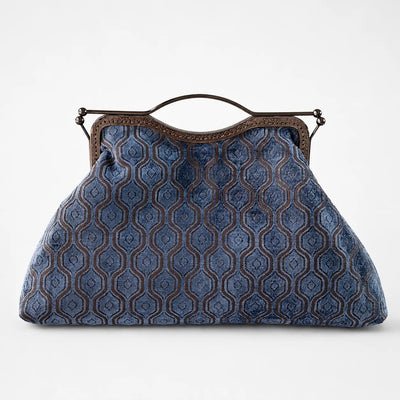
If you have spent any time looking at woven fabric bags, you have encountered both words. Jacquard. Gobelin. They are used sometimes interchangeably, sometimes as if one is superior to the other, and almost never with any explanation of what either actually means.
This is the explanation.
It matters because the two are genuinely different things — different in structure, in visual character, in how they behave as materials for an object meant to last. Understanding the difference does not require a background in textiles. It requires only a willingness to look at what is actually there.
Jacquard: The Method, Not the Fabric
Jacquard is not a fabric. This is the first and most important thing to understand.
Jacquard is a weaving method — a system for controlling individual warp threads on a loom to produce complex, multicolour patterns. It was developed by Joseph Marie Jacquard in the early nineteenth century, and it transformed the textile industry by making it possible to produce intricate woven designs mechanically, without the need for a weaver to manually control each thread.
The Jacquard loom uses a system of punched cards — a technology that would later influence the development of computing — to determine which threads are raised and which are lowered at each pass of the weft. The result is a fabric where the pattern is woven into the structure rather than printed onto the surface. But the specific structure of that weave varies enormously depending on the type of jacquard being produced.
Brocade is jacquard. Damask is jacquard. Tapestry fabric is jacquard. And gobelin is jacquard. They are all produced on jacquard looms. What distinguishes them is the specific weave structure and the resulting material character.
When a brand describes a bag as “jacquard,” they are telling you very little. They are describing the loom, not the fabric. The meaningful question is what kind of jacquard — and that question leads directly to gobelin. For a full explanation of what gobelin fabric actually is, we have covered this in detail separately.
Gobelin: The Specific Thing
Gobelin is a specific type of woven textile with a specific structure and a specific history.
The name derives from the Manufacture des Gobelins, the French royal tapestry workshop established in the seventeenth century under Louis XIV. What that manufactory produced — and what gave gobelin its defining character — was a weft-faced weave: a structure in which the horizontal threads completely cover the vertical ones, so that the surface of the fabric is entirely composed of the decorative weft threads, with no visible ground.
This is what makes gobelin distinct from other jacquard weaves. In most jacquard fabrics — brocade, damask — both the warp and weft are visible on the surface, and the pattern is created by the interplay between them. In gobelin, the warp disappears entirely. The surface is pure pattern, built thread by thread from the weft alone.
The practical consequences of this structure are significant. Gobelin is denser than most jacquard fabrics. It holds its form rather than draping. The pattern has a depth and solidity that other woven fabrics do not.
A gobelin fabric is always jacquard. But a jacquard fabric is not always gobelin. Gobelin is the specific, demanding version of the broader category.
The Structural Difference — Side by Side
| Jacquard (general) | Gobelin | |
|---|---|---|
| What it is | A weaving method | A specific woven fabric |
| Weave structure | Warp and weft both visible | Weft-faced — warp fully hidden |
| Surface density | Varies — can be light or dense | Always dense and structured |
| Pattern depth | Moderate — depends on weave type | High — colour built thread by thread |
| Drape vs structure | Often fluid, drapes | Holds form, structural |
| Durability | Depends on specific weave | Exceptionally durable |
| Best suited for | Garments, linings, soft accessories | Structured bags, upholstery, objects |
What This Means Visually
The structural difference produces a visual difference that is immediately apparent once you know what to look for.
A standard jacquard fabric — brocade, for example — has a surface where the pattern and the ground are both present. The design is created by the contrast between raised threads and the base fabric beneath them. The effect can be beautiful, but it is a surface effect: the pattern sits on top of something.
A gobelin surface is different in character. Because the weft covers everything, the pattern does not sit on a ground — it is the ground. The image is built from colour itself, thread by thread, the way a painting is built from pigment. This gives gobelin its characteristic visual depth: the sense that the pattern has weight, that the colour goes all the way through.
“In gobelin, the pattern does not sit on the fabric. It is the fabric. That distinction changes everything about how the object ages.”
What This Means for a Handbag
For an object that will be carried daily, the structural differences between jacquard and gobelin translate into practical differences in behaviour.
A lighter jacquard does not have the structural rigidity that a handbag requires. It can be used with a heavy internal structure to compensate, but the fabric itself is not doing the structural work. Gobelin is different. The density of the weave means the fabric itself contributes to the structure of the object.
The pattern durability also matters significantly. In gobelin, every thread is locked into the weft-faced structure — there is nothing supplementary, nothing that can snag or pull independently. The pattern is integral to the fabric. This is precisely why gobelin is used in pieces that need to justify their price over years of use. For more on this, see our guide to what makes a handbag worth the price.
Why Hirsch Atelier Uses Both — and When
At Hirsch Atelier, both jacquard and gobelin appear in the collection — but for different reasons and in different contexts.
Gobelin is the primary material for structured pieces: bags where the form is central to the design, where the silhouette needs to hold without heavy internal framing, where the visual depth of the fabric is part of the point.
Jacquard — specifically heavier, more structured jacquard weaves — appears where a different visual register is needed: where the surface should be more fluid, where the pattern should have a different quality of light.
The choice of material for each piece is not a branding decision. It is a design decision. The fabric is selected before the construction begins, because the fabric determines what the construction can achieve. This is the logic of Italian fabric and slow fashion — material first, always.
A Practical Guide to Reading Fabric Labels
| What the label says | What it actually means |
|---|---|
| Jacquard | Woven on a jacquard loom. Could be anything from brocade to gobelin. Ask what kind. |
| Gobelin | A specific weft-faced weave. Dense, structured, pattern integral to fabric. A more precise claim. |
| Tapestry | Often interchangeable with gobelin in commercial use. Verify the weave structure. |
| Brocade | Jacquard with supplementary raised threads. More decorative, less structurally robust than gobelin. |
| Woven fabric | Tells you almost nothing. All of the above are woven. This is the vaguest possible description. |
A Note on Hirsch Atelier
Every piece in the Hirsch Atelier collection is made from Italian woven fabric — gobelin, jacquard, or velvet — selected for its specific weave structure, pattern depth, and suitability for the object it will become.
We do not use the word jacquard as a general term for woven fabric. When a piece is gobelin, we say gobelin. The material is specific, and the description of it should be specific too.
If you are looking for handmade bags in the UAE where the material is described honestly — the collection is at hirsch.ae.
FAQ
Is gobelin a type of jacquard?
Yes. Gobelin is a specific type of weft-faced jacquard weave. All gobelin is jacquard, but not all jacquard is gobelin. Jacquard describes the loom and method; gobelin describes the specific weave structure.
Which is better for a handbag — jacquard or gobelin?
For a structured bag intended for daily use, gobelin is generally superior. Its weft-faced structure makes it denser, more durable, and better at holding form.
Why do brands use the word jacquard instead of gobelin?
Because jacquard is the broader and more widely recognised term. It tells you the fabric was woven on a jacquard loom, which sounds significant without committing to anything specific. Gobelin is a more precise claim.
Can you tell the difference between jacquard and gobelin by looking?
Often yes, particularly up close. Gobelin has a characteristic visual density — the pattern appears to have weight, and the colour goes all the way through rather than sitting on a surface.
What fabrics does Hirsch Atelier use?
Hirsch Atelier uses Italian gobelin, jacquard, and velvet — selected specifically for each piece based on the structural and visual requirements of the design. All fabrics are sourced from Italian mills with established weaving traditions.