The phrase slow fashion has acquired the vagueness that tends to overtake useful ideas once they become popular. It now means everything from buying secondhand to choosing natural fibres to simply buying less. Some of these things are connected. Not all of them are the same.
At its most precise, slow fashion describes a relationship with objects: the decision to acquire fewer things, made with more intention, built to last longer. It is less a shopping strategy than a different way of calculating value — one in which the useful life of an object is part of the price, and the material quality is what determines the useful life.
Italian fabric sits at the centre of this calculation. Not because Italy has a monopoly on quality textile production, but because the specific tradition of Italian mill work — its technical standards, its continuity, its understanding of what fabric is for — produces materials that are genuinely suited to the slow fashion logic.
What Makes Italian Fabric Different
The Italian textile industry is concentrated in specific regions — Como for silk and printed fabrics, Biella for fine wool, Prato for recycled and blended fibres, and the areas around Florence and Venice for woven decorative textiles including gobelin and jacquard. These are not recent concentrations. They reflect centuries of accumulated knowledge, passed through generations of mill workers, designers, and technical specialists.
This continuity matters in practical terms. A mill that has been producing jacquard fabric for four generations has solved problems that a newer operation has not yet encountered. The standards are high not because they are mandated, but because they are the inherited expectation of everyone involved.
Italian mills also maintain a relationship with yarn that is distinct from volume producers. The fibre content, the twist of the yarn, the way it takes dye — these are not incidental details. They are the foundation of the fabric’s character.
Finally, Italian textile production operates at a scale that is incompatible with fast fashion volume. The mills that produce exceptional fabric are not producing millions of metres. They are producing limited runs, often to specification, for clients who understand what they are buying. This structural limitation is, paradoxically, what makes the product exceptional.
The Journey from Thread to Finished Fabric
Slow Fashion Is Not About Buying Less. It Is About Buying Right.
The slow fashion argument is sometimes presented as a moral position: consume less, waste less, do better. This framing is not wrong, but it is incomplete. It focuses on quantity rather than quality.
The more useful frame is economic. A piece made from exceptional material, constructed carefully, designed without reference to seasonal trends, has a useful life measured in decades rather than seasons. The cost per use of such an object is radically lower than the cost per use of a cheaper alternative that needs replacing every year.
Italian fabric is central to this arithmetic because it is one of the few textile categories where the quality is structural rather than superficial. The difference between Italian mill fabric and volume-produced alternatives shows up in how the material behaves over years of use, not in how it looks in a photograph. This is exactly what quiet luxury demands from its materials.
Slow Fashion vs Fast Fashion — The Real Difference
| Fast Fashion | Slow Fashion | |
|---|---|---|
| Material origin | Commodity, unspecified | Named source, specific quality |
| Production volume | Mass, unlimited | Limited, often to specification |
| Design logic | Seasonal trend | Enduring, trend-independent |
| Useful lifespan | 1–2 seasons | 10–20 years |
| Cost per year of use | High | Low |
| What you are buying | Trend access, convenience | Object quality, useful life |
Why Accessories Are the Most Important Category
Slow fashion is often discussed in the context of clothing, where the seasonal logic of fashion is most visible. But accessories — and handbags in particular — are the category where the slow fashion argument is most practically significant.
A well-made bag from quality material will outlast almost any garment. It does not need to fit. A bag designed without reference to seasonal trends can be carried for twenty years without becoming dated, because it was never primarily about the trend.
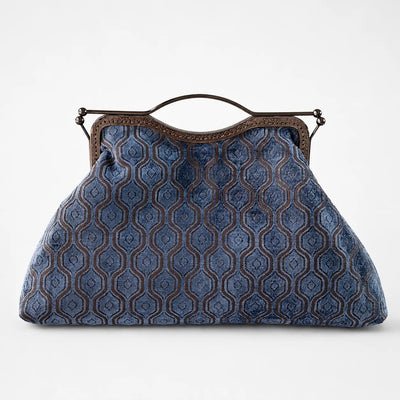
Italian woven fabric — gobelin, jacquard, velvet — is suited to this expectation in a way that most bag materials are not. The pattern is structural, not applied. The material does not separate from itself. It ages without deteriorating. For context on what makes a bag worth the price, the material lifespan is always at the centre of that answer.
“A bag designed without reference to seasonal trends can be carried for twenty years without becoming dated — because it was never primarily about the trend.”
The Hirsch Atelier Position
Hirsch Atelier was built on this logic from the beginning — not as a philosophical commitment to slow fashion as a movement, but as a practical decision about what kind of objects to make.
The materials we use — Italian gobelin, jacquard, and velvet, sourced from mills with established weaving traditions — are selected because they are the right materials for objects intended to last.
Each piece is made by hand, in limited quantity, from fabric chosen for its specific pattern, weight, and structural character. If you are looking for handmade bags in the UAE built on this logic — the collection is available at hirsch.ae.
FAQ
What is slow fashion?
At its most precise, slow fashion describes an approach to acquiring objects that prioritises material quality, durability, and design longevity over seasonal relevance and price accessibility.
Why is Italian fabric associated with slow fashion?
Italian textile mills, particularly those with long production histories, operate at a scale and with a level of technical attention that is incompatible with volume fashion production. The fabrics they produce are structurally superior to commodity alternatives.
Is a slow fashion handbag worth the higher price?
The price comparison depends on the timeframe. A bag that costs three times as much but lasts ten times as long costs less per year of use. The higher initial price is real; the long-term value arithmetic is also real.
What makes a handbag slow fashion?
Material quality, construction method, production volume, and design independence from seasonal trends. A bag made from Italian woven fabric, constructed by hand in limited quantity, and designed without reference to what is currently fashionable, satisfies all four criteria.
Where can I find slow fashion handbags in the UAE?
Hirsch Atelier produces handmade bags from Italian gobelin, jacquard, and velvet in limited quantities. Pieces are available at hirsch.ae and represent a considered alternative to both mass-market accessories and logo-driven luxury.