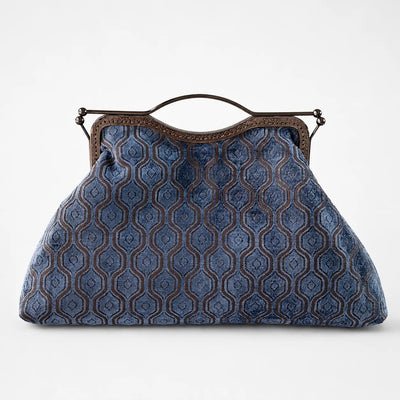
Every decade or so, a fashion editor declares velvet finished. The fabric is too heavy, too formal, too associated with whatever the previous era did with it. And then, quietly, velvet returns — on a runway, in an accessories collection, draped across a chair in an interior that everyone calls effortlessly sophisticated.
This has been happening for five centuries. At some point, the more interesting question is not whether velvet will come back. It is why it never actually leaves.
The answer is structural. Velvet is not a trend that cycles in and out of fashion. It is a material with specific physical properties that produce specific aesthetic effects — effects that remain desirable across cultures, across centuries, and across very different ideas about what luxury should look like.
What Velvet Actually Is
Velvet is a cut-pile weave. In its production, threads are woven over wires or rods that create loops above the base fabric. When the wires are removed, the loops are cut, producing the characteristic upright fibres — the pile — that give velvet its surface.
This structure creates two properties that no other fabric replicates in quite the same way.
The first is directionality. The pile of velvet lies in a direction, and when light strikes it from different angles, it absorbs and reflects differently. Run your hand one way across velvet and it darkens. Run it the other way and it brightens. This is a consequence of the physical structure of the fabric, and it produces a depth of colour that flat-woven textiles cannot achieve.
The second is tactility. Velvet communicates through touch in a way that is immediate and almost universally pleasurable. And they are qualities that photography consistently fails to capture, which means velvet always rewards physical contact more than it rewards being looked at on a screen.
These two properties — directional colour depth and tactile immediacy — are what have made velvet desirable across five centuries. They are not fashionable qualities. They are material qualities. Fashion changes. The material does not. This is why velvet belongs in the same conversation as gobelin and jacquard — materials whose appeal is structural, not seasonal.
A History That Spans Five Centuries
Why It Keeps Returning
The pattern of velvet’s returns is worth examining because it reveals something about the nature of the material’s appeal.
Velvet did not return in the 1990s because 1990s designers decided to reference the Renaissance. It returned because a generation of designers working in a minimalist register discovered that velvet — a fabric with no print, no surface decoration, no pattern in the conventional sense — produced visual interest through structure alone.
This is the quality that makes velvet compatible with quiet luxury, with minimalism, with any aesthetic that values material integrity over surface decoration. Velvet does not need to be decorated. Its interest is inherent. It is already, in itself, enough.
“Velvet does not need to be decorated. Its interest is inherent in its structure. It is already, in itself, enough.”
Velvet Against Other Materials
| Velvet | Gobelin | Leather | |
|---|---|---|---|
| Visual character | Directional depth, colour shift | Woven pattern, architectural | Surface patina, uniform |
| Tactile quality | Immediate, soft, directional | Textured, structured, firm | Smooth, develops with age |
| How it ages | Pile softens, colour deepens | Holds form, pattern stable | Develops patina, softens |
| Photography | Difficult — better in person | Good but loses depth | Photographs well |
| Care required | Moderate — avoid crushing | Low — very robust | Moderate — condition regularly |
| Best context | Evening, occasion, statement piece | Daily use, structured objects | Daily use, all contexts |
Where It Is Going Next
The current moment for velvet is not a revival. It did not go away.
What has changed is the context in which it is being used. The dominant use of velvet in fashion for the past thirty years has been eveningwear — a category that positions the fabric as special occasion, as formal, as the opposite of everyday.
The more interesting direction is velvet in everyday objects — in accessories designed for daily use rather than occasional wear. A velvet handbag is not a statement piece in the way that a velvet gown is. It is an object that brings the material’s qualities into ordinary life: the colour depth visible in daylight, the tactility present every time the bag is picked up. For practical guidance on caring for velvet pieces, see our complete guide to fabric handbag care.
Velvet at Hirsch Atelier
At Hirsch Atelier, velvet appears in the collection as a material chosen for specific pieces where its properties are exactly what is required: where the visual depth of the pile suits the design, where the tactile quality is part of the object’s character, where the colour — in a deep burgundy, a midnight blue, a forest green — needs the dimensionality that only velvet provides.
We do not use velvet as a trend reference. We use it as a material — selected because it is the right material for the specific object being made. If you are looking for handmade bags in the UAE made from velvet or other Italian woven fabrics — the pieces are available at hirsch.ae.
FAQ
Why does velvet keep coming back in fashion?
Because its appeal is material rather than aesthetic. The directional colour depth and tactile quality of velvet are properties of its physical structure — they do not date, because they are not stylistic choices.
Is velvet practical for a handbag?
With appropriate construction, yes. The considerations are specific: velvet should not be crushed for extended periods, and it benefits from occasional brushing to restore the pile direction. A velvet bag constructed with these properties in mind is a practical daily object, not a fragile one.
How do you care for a velvet handbag?
Brush gently with a soft brush in the direction of the pile to restore surface after use. Avoid prolonged contact with rough surfaces. Store in a dust bag, not compressed under other objects. Steam lightly if the pile becomes flattened; do not iron directly.
What colours work best in velvet for accessories?
Deep, saturated colours benefit most from velvet’s directional depth. Burgundy, midnight blue, forest green, and dark teal all gain dimensionality from the pile structure that flat-woven fabrics cannot replicate.
Is velvet a luxury material?
Historically, yes — velvet was among the most expensive textiles in medieval and Renaissance Europe, reserved for royalty and the very wealthy. Modern production has made velvet more accessible, but quality velvet remains a material that communicates luxury through its physical properties rather than its label.