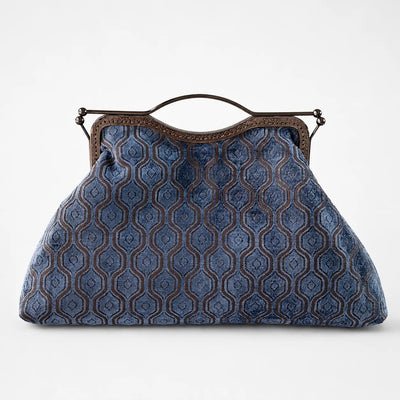
The object you carry every day has a history that spans five centuries. It has been a tool, a status marker, a political statement, a canvas for craft, and a vehicle for identity. It has been made from leather, from tapestry, from beaded fabric, from coated canvas, and from woven Italian textile. It has been worn at the waist, carried in the hand, slung over the shoulder, and clutched under the arm.
What it has always been is consequential. The handbag is one of the few objects in daily life that is simultaneously functional and expressive — that must do a specific practical job while also communicating something about the person carrying it. This dual requirement has shaped its evolution across every era, and understanding that evolution makes the object itself more legible.
The Handbag Through the Centuries
The Beginning: Function Without Pretension
The earliest bags were not handbags in any contemporary sense. They were pouches — small, practical, worn at the belt or carried in the hand — designed to hold coins, keys, and the small necessities of daily life. In medieval Europe, these pouches were often made from leather or woven fabric, sometimes embroidered as a demonstration of skill or as a gift between people of significance.
Both men and women carried them. The distinction was not gendered but practical: the pouch was a tool, and tools are used by whoever needs them. The idea of the bag as a specifically feminine object came later, as a consequence of fashion rather than function.
The transition began in the sixteenth and seventeenth centuries, when European dress became increasingly tailored and pockets — which had been incorporated into looser garments — became impractical or invisible. Women's dress, in particular, moved toward silhouettes that could not accommodate functional pockets without disrupting the line. The external bag became necessary precisely because the garment had become decorative.
The Seventeenth and Eighteenth Centuries: Craft as Status
As the bag moved from purely functional object to visible accessory, it became a vehicle for craft. Embroidered bags — worked in silk thread on canvas or linen, sometimes depicting pastoral scenes or floral designs that echoed the tapestry tradition — were status objects as much as practical ones. The skill of the embroidery communicated the wealth and refinement of the household from which the bag came.
This is the period when the visual vocabulary of the decorative bag was established. The patterns that appear on gobelin and jacquard bags today — florals, geometrics, botanical motifs — are not modern inventions. They are continuations of a decorative tradition that developed in this period and has been sustained, with varying degrees of self-consciousness, ever since.
The tapestry bag of the seventeenth century was not a fashion object in the contemporary sense. It was a craft object — made slowly, by skilled hands, to last for generations. It was expected to outlive its first owner. This is precisely the tradition that Italian fabrics and slow fashion continue today.
The Nineteenth Century: Function Returns, Then Status Again
The nineteenth century produced two distinct moments in the history of the bag. The first was the reticule — a small, soft bag carried in the hand, which became the standard accessory for women in the early part of the century. The reticule was practical in the narrow sense: it held what a pocket would have held. But it was also, immediately, a canvas for decoration and a signal of taste. The material, the embroidery, the clasp — all of these communicated something about the person carrying it.
The second was the development of structured luggage and travel bags, driven by the expansion of rail travel. The great leather goods houses of Europe — many of which still exist under their original names — developed in this period to serve the specific needs of travellers who required bags that could withstand the conditions of travel while communicating the status of their owners. This is the origin of the luxury leather goods tradition that has dominated the category ever since.
The Twentieth Century: The Logo Arrives
The twentieth century transformed the handbag from a craft object into a brand object. The shift happened gradually, then suddenly. Through the first half of the century, the bag remained primarily a craft object, differentiated by the quality of its material and construction. The great houses produced work of genuine distinction — leather goods of a standard that reflected the full weight of the European craft tradition. The name on the bag was a guarantee of quality, not the primary product.
The second half of the century changed this. As the luxury market expanded — first into the aspirational middle class, then into genuinely mass markets through licensing and lower-priced lines — the logo became the product. The monogram, the recognisable hardware, the immediately identifiable silhouette: these were the things being sold, and the material quality became secondary to the visibility of the brand.
By the 1980s and 1990s, the logo had become so dominant that it was possible — and commercially very successful — to produce bags where the material was essentially a vehicle for the branding. Coated canvas, chosen not for its quality but for its capacity to carry a monogram at scale, became one of the most profitable materials in the history of the luxury industry. This is the shift examined in our comparison of Italian jacquard vs. mass-market production.
The Bag in Different Eras
| Era | Primary function | Dominant material | What it communicated |
|---|---|---|---|
| Medieval | Utility | Leather, woven cloth | Practical need |
| 17th–18th C. | Status + utility | Embroidered fabric, silk | Craft skill, refinement |
| 19th C. | Travel + occasion | Leather, beaded fabric | Social position, taste |
| Early 20th C. | Daily carry | Leather, Art Deco metals | Modernity, independence |
| Late 20th C. | Status signalling | Coated canvas, logo leather | Brand recognition, wealth |
| Now | Identity + craft | Woven textile, quality leather | Material knowledge, specificity |
Where the Object Is Now
The logo era is not over. It is simply no longer the only story. Alongside the continued dominance of recognisable brands, a different kind of bag has become more visible — one in which the material is the point again, as it was before the logo became the product. This is not nostalgia. It is a recognition that the craft tradition — the embroidered bags of the seventeenth century, the woven textile accessories of the eighteenth, the carefully constructed leather goods of the nineteenth — was built on a logic that the logo era interrupted but did not end.
The bag that communicates through its material rather than through its name is not a new idea. It is the oldest idea in the history of the object. What is new is that it is being chosen deliberately, in a market that offers the alternative so prominently. This shift is part of what quiet luxury describes — and it has particular resonance in a market like Dubai, where the contrast between visibility and material substance is most legible. A growing number of buyers are also looking specifically for handmade alternatives in the UAE that reflect this older logic.
"The bag that communicates through its material rather than through its name is not a new idea. It is the oldest idea in the history of the object."
A Note on Hirsch Atelier
Hirsch Atelier makes bags from Italian woven fabric — gobelin, jacquard, and velvet — in the tradition of the decorative textile accessory that existed long before the logo became the dominant language of luxury. Each piece is made by hand, in limited quantity, from fabric chosen for its specific character.
This is not a historical project. It is a practical one: the material tradition produces the best objects, and the best objects are worth making. The history is context, not justification.
The collection is at hirsch.ae.
FAQ
When was the handbag invented?
The handbag in its modern form — a carried bag designed specifically for daily use — developed in the nineteenth century, driven by changes in women's dress and the expansion of rail travel. Its precursors — belt pouches, embroidered bags, reticules — extend back to the medieval period. The object has a continuous history of at least five centuries.
Why did handbags become status symbols?
The shift from functional object to status symbol happened gradually, as the bag moved from a practical necessity to a visible accessory. By the seventeenth and eighteenth centuries, the craft quality of the bag communicated the refinement of its owner. By the twentieth century, the brand name had replaced craft quality as the primary status signal — a shift that defined the luxury industry for several decades.
What were the first luxury handbags made from?
The decorative bags of the seventeenth and eighteenth centuries were typically made from embroidered fabric — silk thread on canvas or linen, worked by hand. The leather goods tradition that now dominates the luxury market developed primarily in the nineteenth century, driven by the needs of travellers and the capabilities of the great European leather goods houses.
Why are woven fabric bags historically significant?
Woven fabric bags predate the leather goods tradition by several centuries. The embroidered and tapestry bags of the seventeenth and eighteenth centuries were among the most valued accessories of their era — made slowly, by skilled hands, from materials chosen for their quality and visual depth. The contemporary gobelin or jacquard bag is a continuation of this tradition, not an innovation within it.
Where can I find historically-inspired woven fabric bags?
Hirsch Atelier produces handmade bags from Italian gobelin, jacquard, and velvet — materials with a long history in European decorative craft. The collection is available at hirsch.ae.